Digging into the Maya mystery
In the jungles of Belize, near the southern border of United Mexican States, rise giant stone pyramids. I've seen deadly snakes lurk in that area, as comfortably A venomous scorpions, tarantulas the size of a grownup's hand and swarms of killer bees. Disdain these dangers, volunteers much atomic number 3 myself come here to help archaeologists at the site bring out clues to a traditional mystery. The question that we hope to solvent: What caused the collapse of the ancient empire that created these monuments?
The past Maya civilization was an empire the size of Texas. Its cities and fields in use what is right away southern United Mexican States and northern Central America, including the countries of Guatemala, Belize, El El Salvador and Honduras. The height of the Mayan language empire, known as the Standard period, stretched from close to A.D. 250 to at least 900. During this time, at the least 5 million and perhaps as many as 25 million multitude lived there. The empire's population density, surgery the great unwashe per transparent statute mile, was greater than that of medieval European Economic Community.

The Maya had what was arguably the most advanced civilization in the Americas. For exercise, they ready-made dramatic breakthroughs in astronomy that helped them very accurately predict where the moon and other planets would be in the sky centuries in the future. They also left behind many books and stone inscriptions that listed the stories of their gods and the history of their divine kings and Queens. These historical records were written in a voice communication made of hieroglyphs, special pictures that stand for words or sounds.
Then, for unknown reasons, the ancient Maya refinement collapsed more than a thousand years ago. The number of hoi polloi declined catastrophically to a fraction of the empire's former sizing. The ruins of its great cities are forthwith for the most part wooded by jungle. The descendents of this civilization, the modern Maya, however live in the Americas.
Scientists want to solve the puzzle near how the past Maya lived and what ended their refinement. To do and so, the Maya Research Program has been investigating for cardinal decades an area known as Puritanic Creek, in western Belize. This region is named after the nearby Rio Azul, which agency "blue river" in Spanish.
Life in Blue Creek
Both 25,000 Maya once called Spicy Creek menage. This would take up made it a relatively pocket-size population concentrate. However, the area appears to have been unusually important. E.g., the one-fifth-largest known ancient Maya memory cache of jade — a jewel — was discovered at Blue Creek. In ancient Mayan culture, jade interred with a person often means the person was important (or maybe connected to someone important). At Dreary Creek, "true Robert Ranke Graves of poor folk music at that place have been found with jade," said Tom Guderjan, manager of the Maya Research Program.
Every summer, researchers and volunteers such as myself make camp at Blue-blooded Brook. Our dwellings are hilltop cabins made of metal sheets. In this manner, we are ilk the ancient Maya, who preferred living up full, where the air is breezier and clear of many of the mosquitoes buzzing belt down near the water.
Around the camp are Saccharum officinarum fields and cattle pastures that are often misty at daybreak. These more often than not belong to nearby communities of Mennonites. Umpteen populate in this religious group still avoid using present-day engineering science and tail be seen awheel the roads in horse-drawn buggies. Others, however, do use tractors and other modern conveniences.
Digging in the ruins
Research at Aristocratic Creek involves us crowding into pickup trucks all morning. We beat back over very bumpy and often turbid roadstead, sometimes in the pouring rain. The way we swerve back and away and bounce up and down can make it feel like we'atomic number 75 awheel in a chute-the-chute and on a bucking bronco at the same time.
On several years, we hunt for new Maya sites in Blue Creek. This involves roaming the jungle, chopping our way tense vines with machetes. Many ancient Maya buildings are visible as bumps on top of nearby hills.
Most days, we excavate ruins. This involves lugging buckets of equipment, jugs of water and bags of food up tortuous and slippery trails. Sites are sometimes given unforgettable names so much as Chum Balam-Nal (CHUM atomic number 56-lum NAHL), which way "Set up Where the Jaguar Rules," because a panther was erstwhile tainted there.
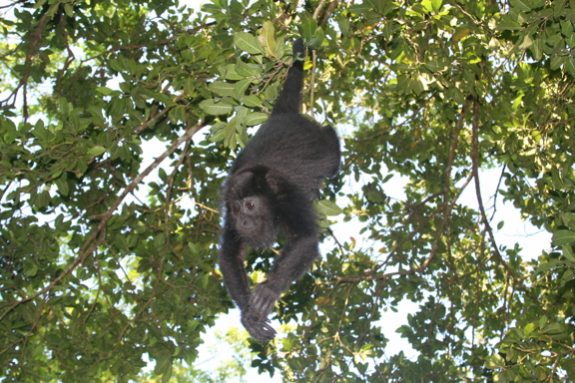
We do keep an optic out for venomous snakes and other dangerous animals. However, most wildlife we see is relatively harmless, like the howler monkeys that plaint loudly in the morning. Still, they do like to bedevil poop at people, and my group keeps an eye on the treetops ever since unmatchable of my friends was hit with muck about droppings.
Research crews work a variety of structures, including buildings where Maya lived and pyramids where sacred rituals took place. Excavating them involves initial using shovels and pickaxes to remove nearly of the soil that covers the buildings. Crews then hack down trees and cut roots at the situation. All of this fire take hours — if non days — of dirty, sweaty work. To keep us expiration, Mayan Research Course of study intern Sam Mclellan blasts music from his iPod through speakers. It derriere feel epic hanging from a vine on the side of a pyramid piece digging forth in the rain to the sounds of heavy metal.
Carefully uncovering old secrets
We start digging with more care when the earth turns from dark brunette to pale topaz. This change in colour suggests we are getting nearer to the white limestone from which past Maya ruins were successful. We switch to paintbrushes, handpicks and trowels so that we don't risk damaging any artifacts we might key out.
Everything we are looking for is mostly hidden, so finding it lav be very challenging. How do we dig to expose buildings and not accidentally destroy something priceless?
Greg Savoie of the Maya Research Syllabu says that when things get confusing, it helps to live a bit around how the antediluvian Mayan thought. For illustrate, Savoie said, "they liked their buildings symmetrical." He pointed out to his crew at Chum Balam-Nal the likely layout of a structure existence unearthed. "If we find a rounded corner on one side of the edifice," he explained, "we should expect to find another one on the other side."
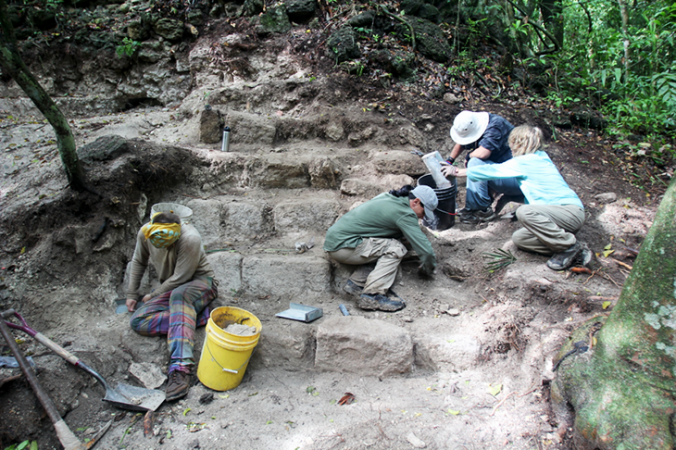
We typically fill and empty piles of buckets of dirt and rock daily. Sometimes we deck this earth onto metal screens and so shake the screens to strain out grains of sand and dirt. Leftovers hindquarters include tiny Mayan language artifacts such as carved shells and blades made of dark mountain glass titled obsidian.
Human remains such as bones and teeth can reveal what diseases the ancient Maya pale-faced, or whether they were sacrificed. Even broken sherds of pottery tooshie leave vital details. For instance, a type of pot decoration known as a basal rim privy reveal that it came from the Archeozoic Classic period, A.D. 250 to 600, explained Maya Research Program's Colleen Hanratty. But then, a kinda dark coloring titled Achote Black may designate a piece that came from the Late Classic period, A.D. 600 to 830, she said.
Hours or years of hard work can pass ahead somebody finds an artifact or uncovers a construction. Shut up, the feeling you get when you reveal something is an wondrous reward. In June, our group revealed human being statuettes, for instance, happening crowning of a three-story-tall pyramid. They might possess been left there as offerings after the fall of the ancient Maya, possibly by their descendents.
In a 2008 sashay, I helped discover a bedroom underneath a building that seemingly once held a shrine. Underground spaces were often sacred to the ancient Maya, who believed so much places were connected with the underworld.
A big word-painting shapely of many another pieces
Over the yesteryear few decades, the Maya Research Curriculum has deepened many clues about what life in Blue Creek was once the likes of. Any one artifact usually has very smaller significant by itself and rather gains significance when archaeologists see how it connects with other finds or its surroundings. E.g., if an item was found in a grave, information technology was probably valuable. If it was found in a garbage tidy sum outside a house, it probably had little value.
To archaeologists, smooth that "food waste" offers clues to understanding why the ancient Mayan disappeared.
Volunteers and researchers with the Mayan Research Program are not in the jungles of Belize to hunt treasure but to save it. Though looters who slip away valuable artifacts can do incalculable trauma to archaeologists' understanding of the ancient empire, criminals have unfortunately raided a number of sites at Blue Creek. Luckily, scientists flying this excavation are friendly decent with the topical anaestheti community to at times retrieve stolen artifacts.
The picture that researchers are developing of past Blue Creek suggests it was a meaning site. It was located at the end of a major river used as an important trade route by the ancient Maya. The site also contains a vast network of ditches that helped irrigate fields with water. That would have successful crop production very efficient, said Mayan language Research Program's Samantha Krause.
Indeed, such details mightiness explain why Blue Creek acquired unusual wealth. They might also assist explain the terminate of the ancient Maya civilization.
The empire was made of many kingdoms and communities that grew progressively depending on each other over time. That dependence power also have made each biotic community less capable of living on its own. Patrician Brook obviously grew more crops than information technology needful, which would have allowed it to send off extra food to assist feed other areas. The prevailing mind on why the ancient Maya culture disappeared is that environmental catastrophes such as droughts disrupted the networks that tied communities together. A disaster that endangered Down Brook, for instance, mightiness have got had Antoine Domino effects, rapidly causing disasters to develop in neighboring communities.
"The past Maya had a much more coordination compound high society than they'ray often given credit for, and they might give birth lessons for our personal metre," Guderjan said. "We sleep in a world where we face challenges with our environment, and our companionship is conterminous tightly with others."
Blue Creek mightiness as wel point to the complexity of the collapse of the ancient Maya refinement. For instance, while the primary shopping centr at the center of Blue Creek was abandoned roughly between A.D. 830 and 1100, Chum Balam-Nal and other sites may deliver survived thirster, by other generation or so, Savoie said. That power mean these areas confederative themselves with outsiders as the ancient Maya refinement was collapsing.
Clearly, Guderjan says, "There's much many that Bluish Creek has to teach the States."
0 Response to "Digging into the Maya mystery"
Post a Comment