Blaxidermy Pink Installation as Part of Red Bull Arts Detroit Resident Exhibition
The second edition of Detroit Art Week (DAW)—organized by its co-founders Aleiya Lindsey and Amani Olu—was a jam-packed, exhausting, and thrilling affair. The event, which took place July 17–21, included 36 exhibition openings, 13 performances, 7 panel discussions, works by 150 artists from Detroit and all over the world, and was host to many, many parties and studio visits. But, apart from the scale and expanded programming, this item iteration truly hit dwelling house (or at least attempted to) Detroit'southward rapid clout in the art world as an international hub for cultural exchange.
A fascinating facet of the program this yr was its emphasis on place, both physical (e.g. hotel room, business firm, gallery infinite, neighborhood, metropolis) and conceptual (east.thou. identity, culture, refuge, escape, darkness). This manifested through themes of displacement, gentrification, and race—hot push button topics in Detroit especially, but too beyond the globe—but resulted in a critical mass of works that, intriguingly, focused on site-specificity and materiality non just to honor local histories, but as a means to discover points of symbolic connectedness between Detroit and the exterior globe.
Transitional Spaces
I of the many highlights of DAW was "Young Curators, New Ideas Five" (YCNIV), the fifth in a serial of group exhibitions first founded in New York in 2008 by Olu. YCNIV showcased a medley of small exhibitions by 12 contained curators inside the Trumbull & Porter Hotel in the Corktown neighborhood.
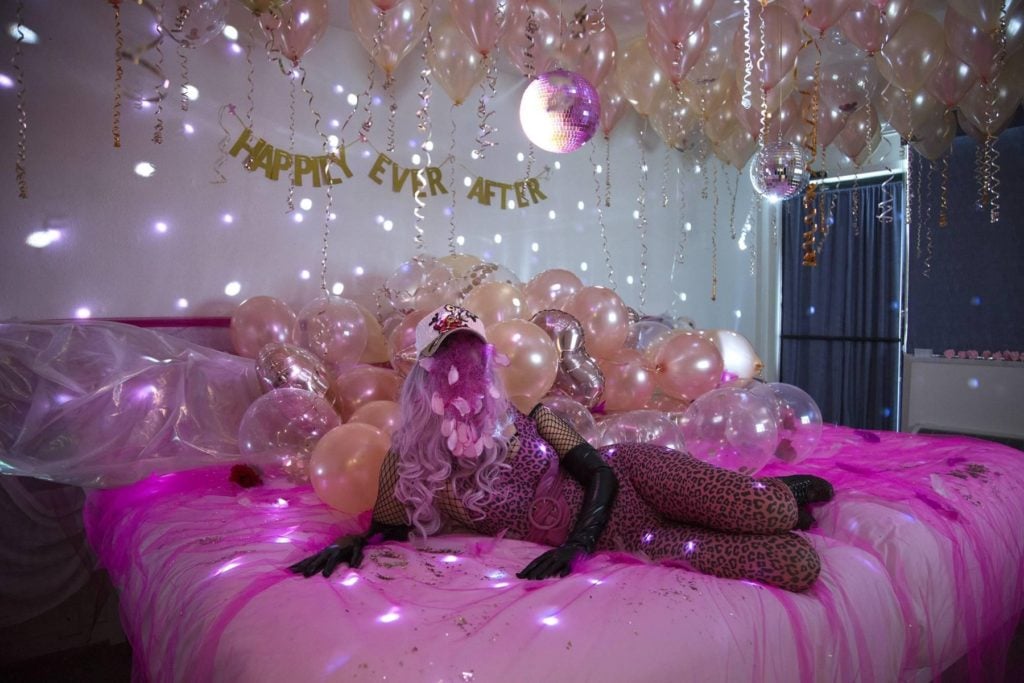
Katarzyna Perlak, Wish Landscapes (2019). Image courtesy of Detroit Fine art Calendar week. Photo: Paul-David Rearick.
Each invited curator took over a hotel room on the beginning floor and presented works by artists who explore problems of race, identity, gender, sexuality, and gentrification. The curatorial projects transformed each room into a site-specific installation that ofttimes utilized or made reference to the space's inherent part as a chamber or hotel room.
This was true of the event's highlight this year, "Wish Landscapes," curated past Kasia Sobucka, the founding director of the London-based arts nonprofit Arts Territory. She presented the work of Shine creative person Katarzyna Perlak, who decorated the hotel room every bit a honeymoon suite, festooned with pink balloons and glitter all over the bed and a "Happily Always Afterward" garland attached to the wall.
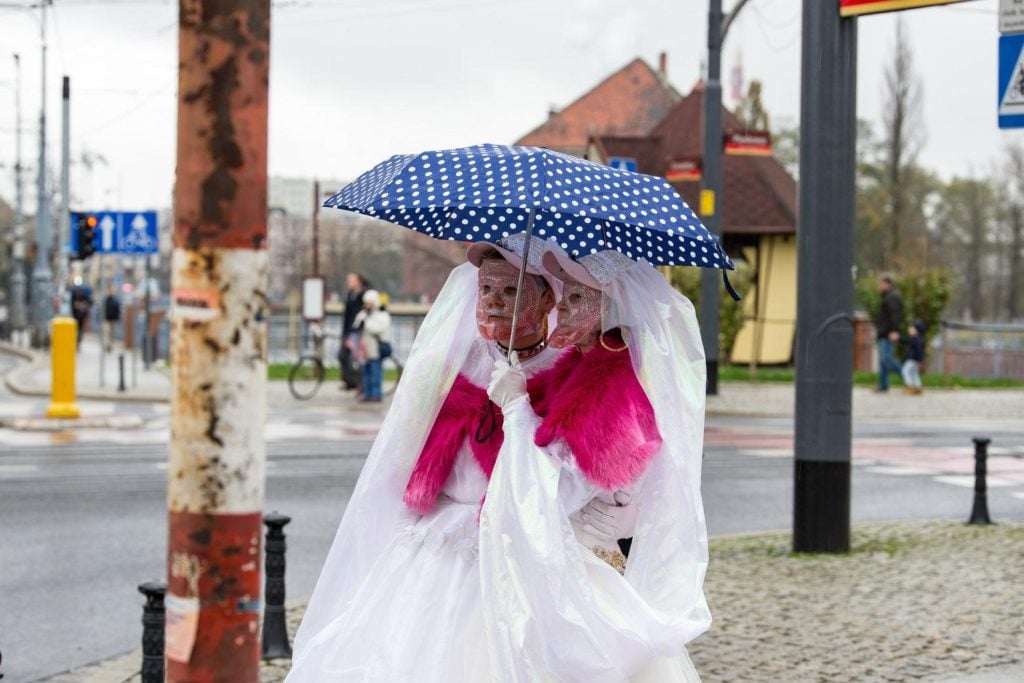
Katarzyna Perlak, Happily E'er Later on (2019), Video Still. Courtesy of Detroit Art Week.
Sobucka's infinite also featured a 20-minute video aptly titled Happily Ever After (2019) that documents the performance of a fictional lesbian wedding interspersed with footage of Polish nationalists protesting at Pride parades in diverse dissimilar cities across Poland. Perlak's queering of national traditions (the union was performed equally a traditional Polish hymeneals) as an act of resistance is all the more trenchant every bit aforementioned sex marriages are outlawed in Poland. But the work too plays with notions of utopia and hope, creating an imaginative safety infinite inside the hotel where same-sexual practice marriages can ostensibly occur openly and not in secret.
This idea of an imaginary safety infinite was also at play in the work of Pamela Quango, presented at Red Balderdash Arts Detroit (on view through August 25). One of three artists spotlighted in the Blood-red Balderdash Residency Art Exhibition, Council's exhibition too deals pointedly with the thought of personal history and trauma, however here with a generous dose of humor and camp.

Pamela Council, BLAXIDERMY Pinkish (2019). Image Courtesy of Red Bull Arts.
In BLAXIDERMY Pink (2019), Council presents a shrine to her xiv-year-old self: a frail pink infinite with a plush carpeting; fondue fountains spewing gallons of Luster'due south Pinkish Moisturizing Hair Balm (an African American hair production that Council remembers fondly from childhood); a Sqweel 2 oral-sex toy dangling overhead on a string; mounted field hockey sticks that the creative person used equally weapon for self-defence force against child corruption; and silicone reliefs of the soles of her favorite sneakers.
In effect, the space is filled with objects that agree emotional weight and have their own relations to a particular identify and time for the artist. Council has created an environment to house these transitional objects (i.e. objects that provide psychological comfort), in turn building a "transitional" infinite for herself and for her viewers to experience.
Material Civilisation
The function of objects as markers of culture and history shaping identities and stories was a theme elsewhere. Consider Bree Gant's piece Otherlogue (2019), part of "Show Me Your Shelves!," an exhibition organized by Gimmicky And (C&), a magazine and website that focuses on contemporary fine art from Africa and its diaspora, at dissimilar branches of the Detroit Public Library.
At the Skillman Library, the Detroit-based Gant's piece consisted of a scatter of many empty glass jars, one empty bottle of Hennesey, mussels, and cowrie shells, evoking the story of "Eez," a fictional black female artist in Detroit. The scene is ritualistic in tone, the drinking glass jars looking to have been used to cast protective spells, a common trope in many traditions of folk magic.
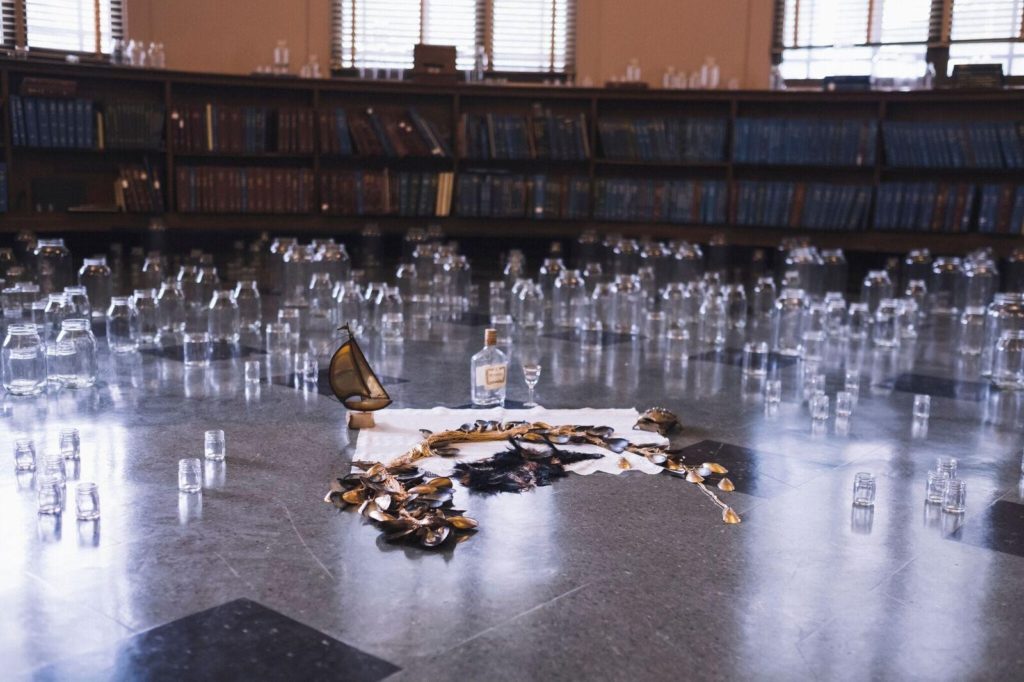
Bree Gant, Otherlogue (2019) at the Skillman Library. Photograph: Kashina Dowridge
Perhaps the exhibition that calls virtually attending to this idea of objecthood (and more than specifically material) equally a stand-in for identity and place is "Landlord Colors: On Fine art, Economy, and Materiality" (on view through Oct half-dozen). Presented at Cranbrook Fine art Museum, "Landlord Colors" —which borrows its championship from a term coined by John Baldessari to draw inexpensive paint and unappealing colors—presents the work of 5 international fine art scenes that experienced times of crisis: Detroit, starting from the 1967 Rebellion and ranging to the present; Arte Povera in Italy, from the 1960s to the 1980s; Republic of korea in the authoritarian 1970s; Cuba during the fall of the Soviet Matrimony in the 1990s; and finally Hellenic republic since its fiscal crisis in 2009.
The show, which is exceptionally researched and curated by senior curator Laura Mott, takes a look at the regional histories of five distinct cities and how artists responded to the social and economic unrest of the time through eclectic and often discarded materials (wood, marble, concrete, material, etc.).
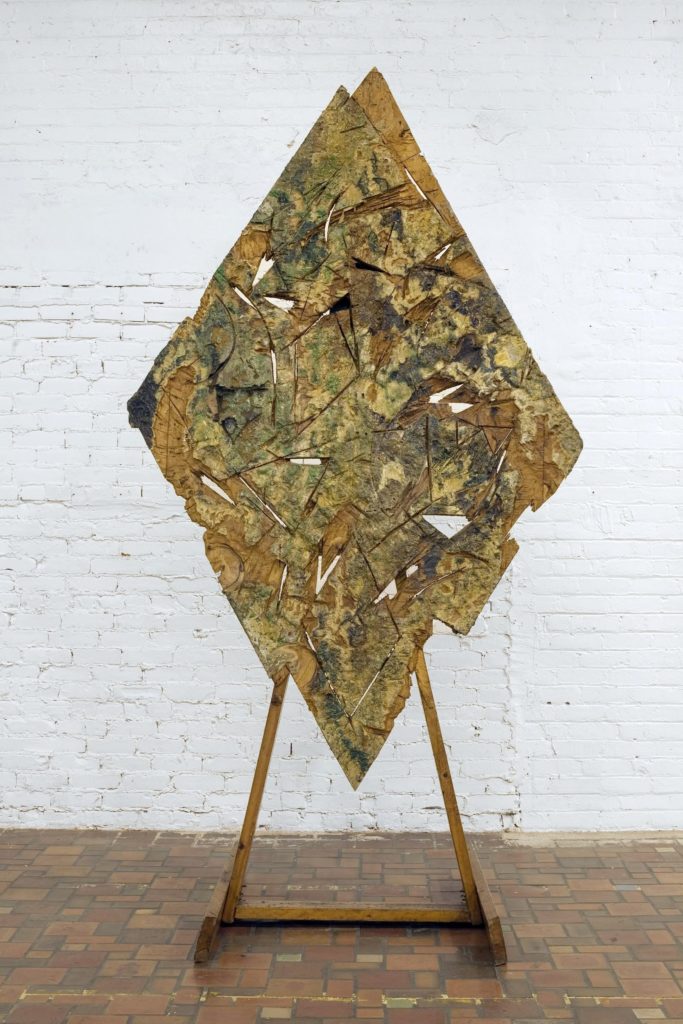
Gordon Newton, Diamond Follow (1975). Courtesy of Cranbrook Art Museum.
Works by Detroit artists Gordon Newton, Tyree Guyton, and Charles McGee are all created from leftover materials from abandoned homes in various neighborhoods of Detroit. Some objects are reworked and manipulated, such as Newton'southward Diamond Follow (1975), a large plywood panel with notable cutouts and paint marks. Others are just left untouched, such as Charles McGee's "Urban Extract" series, for which the creative person displays large architectural fragments of buildings and homes as paintings or sculptures.
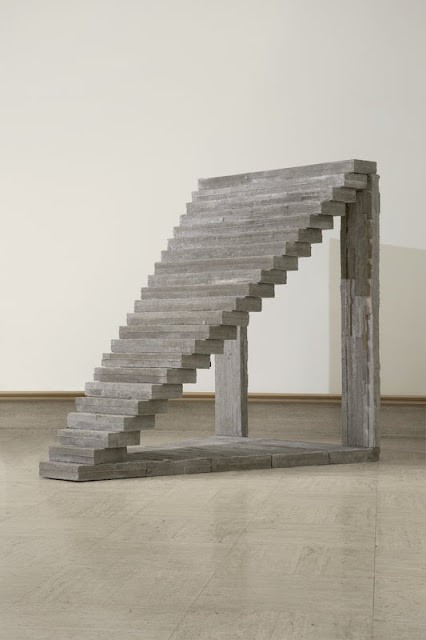
Kostis Velonis, Assembly of a Tenement (polykatoikia) (2019). Courtesy the artist.
Fast forwarding 40 years subsequently, the show illustrates how Greek artists Andreas Lolis and Kostis Velonis have hit upon similar strategies, except here in a colloquial that speaks to the history of Athens. In Assembly of a Tenement (2019), Velonis recreates a section of an amphitheater out of concrete.
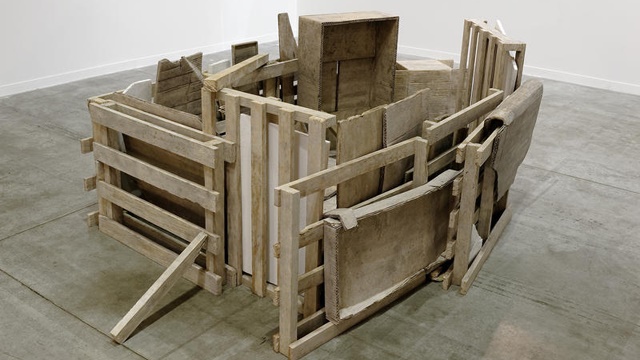
Andreas Lolis, Permanent Residence (2015).
Alternatively, in Permanent Residence (2015), Lolis makes employ of discarded packaging materials such as cardboard boxes and wooden pallets, examples of detritus often used past homeless immigrants to build makeshift homes. However, on closer inspection, in his sculpture these transient objects are really crafted out of marble, hearkening back to the materials of ancient Greek sculpture, and through it, to questions near the symbolism of national identity.
Home of the Dauntless
Complementing "Landlord Colors" is "Material Detroit," a functioning and public art series organized by Mott, Taylor Renee Aldridge (co-founder of the website ARTS.BLACK), and Ryan Myers-Johnson (executive director and curator at Sidewalk Detroit). It featured an all-encompassing program of performances throughout the city, includingAlma (Soul), a tribute in music to Detroit's 1967 Rebellion, which, reflecting Detroit Fine art Calendar week'southward local-international dialogue, was orchestrated past Susana Pilar, who is actually an Afro-Cuban creative person.
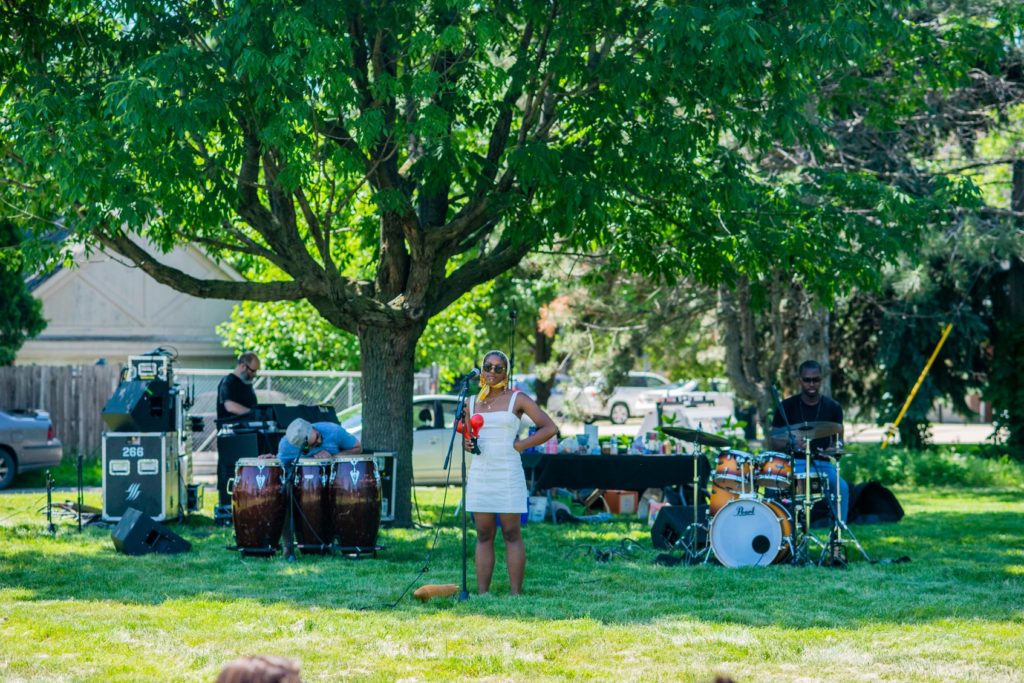
Susana Pilar, Alma (2019). Photo: past Sarah Blanchette
Ane of the hallmarks of "Cloth Detroit," nonetheless, was a site-specific installation past Anders Ruhwald, titledUnit 1: 3583 Dubois and occupying an entire apartment in a two-story building in Eastern Market. The permanent installation is a dimly lit, labyrinthine infinite of six rooms all in black. The infinite has a sinister quality, simply is also quite calming and beautiful in its sheer starkness. Works in black ceramics and molten glass fill most of the rooms, while the forest planks of the walls are carefully charred to a deep, rich charcoal black.
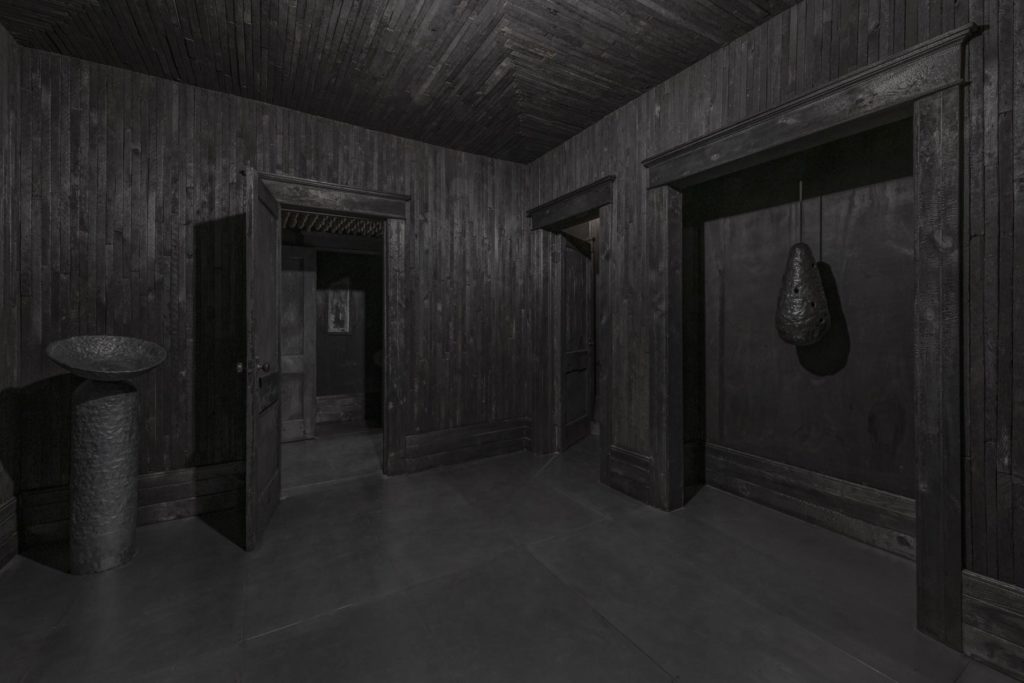
Anders Ruhwald, Unit of measurement one: 3583 Dubois (2016). Installation View. Courtesy Volume Gallery and the artist.
Born in Kingdom of denmark, Ruhwald moved to Detroit in 2008 at the time of fiscal crunch in which millions of Americans lost their homes. Housing has a particular place in the American ethos—and specially in Detroit. Unit of measurement 1: 3583 Dubois not simply recalls the prototype of abandoned homes across Detroit from the '70s to the present, just besides stands as a dour monument to the city's descent into bankruptcy in 2013. It becomes a keeper of memories of loss, of things forgotten or even erased.
Detroit At present
Detroit and its fate has stood as a metonym in the imagination for both America and black America specifically. A terminal piece of work from Detroit Art Week that stood out for channeling this sense was Helina Metaferia'south functioning At present (2019), which took place on July 18, 2019 at the Museum of Contemporary Fine art Detroit.
Metaferia, who is an Ethiopian-American creative person based in New York, worked with 3 local Detroit artists to come up with an interpretive operation on the question of what America ways to them. She had met her collaborators just days earlier the 30-infinitesimal operation, so the slice was loose, abstract, playful, experimental, and at times very awkward.
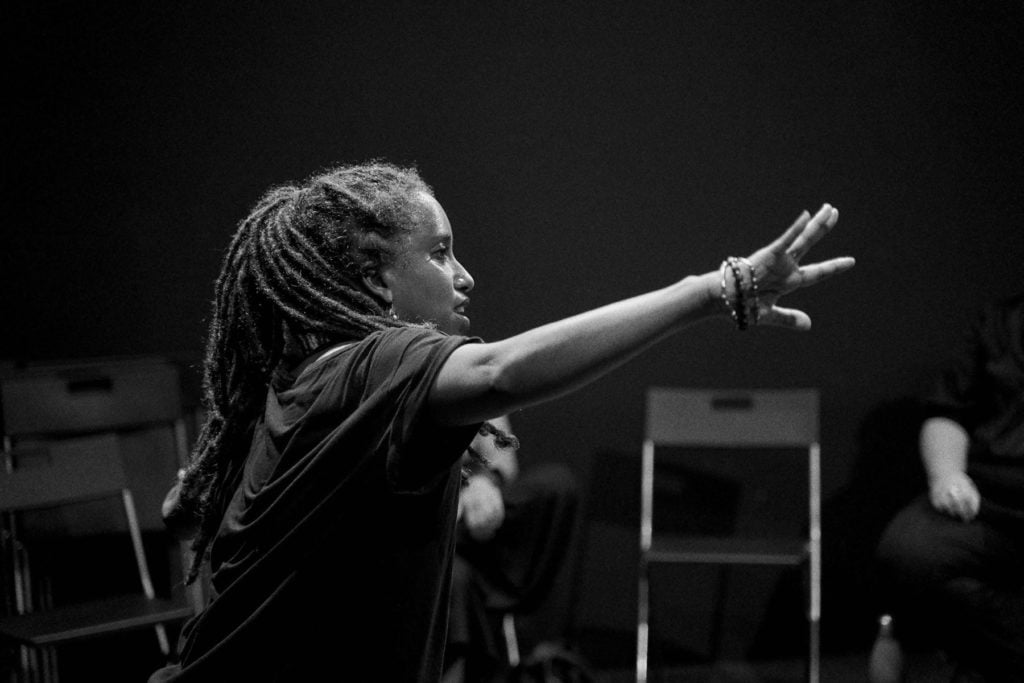
Helina Metaferia, The Now (2019), operation, Museum of Contemporary Art Detroit (MOCAD).
Photo: Aaron Barton. Courtesy of MOCAD.
But that seemed to be the betoken, to share a infinite together and feel a piffling uncomfortable. At one signal, Metaferia gingerly walked effectually the space, microphone in hand, ominously maxim, "America is…," and and so pointed the microphone into the face of an audience member and waited for their response. The experience was quite overwhelming. Many of the responses were to be expected because the crowd: "America is racist," "America is imperialist," etc.
Just what felt most poignant was the showtime of the piece. Metaferia stood alone, moving around the room yelling, screaming, laughing, gesticulating, and crying. As if she were undergoing a mental break, she cycled speedily through real moments of glee and despair. Her performance was viscerally evocative of the blackness American or African Diasporic feel: a sense of black that means a constant rejiggering of self and identity in order to survive or navigate systemic racism.
The work as well recalled, for me, a line from Taylor Renee Aldridge's essay in the catalogue for "Landlord Colors." In it she states that "[b]lackness and its agents… become amorphous, a form that evades a specific place or fourth dimension. It is all place, all time." The same can be said of Detroit equally a site and as a symbol, as glimpsed through the expansive lens of Detroit Art Week.
Follow Artnet News on Facebook:
Want to stay ahead of the fine art earth? Subscribe to our newsletter to go the breaking news, eye-opening interviews, and incisive critical takes that drive the conversation frontwards.
Source: https://news.artnet.com/art-world/detroit-art-week-2019-1612339
0 Response to "Blaxidermy Pink Installation as Part of Red Bull Arts Detroit Resident Exhibition"
Post a Comment